Case Study

Agent Travora IA - AI Powered Travel Planning System

A product thinking case study exploring the information architecture and AI workflow of an intelligent travel planning assistant that generates personalized trip itineraries.

AI Product DesignInformation ArchitectureTravel TechConversational UXProduct StrategyAI Assistant UXSystem Design
Agent Travora IA - AI Powered Travel Planning System - UI/UX design case study by Saurabh Pansari

1. Project Hero

πŸ€– Agent Travora IA

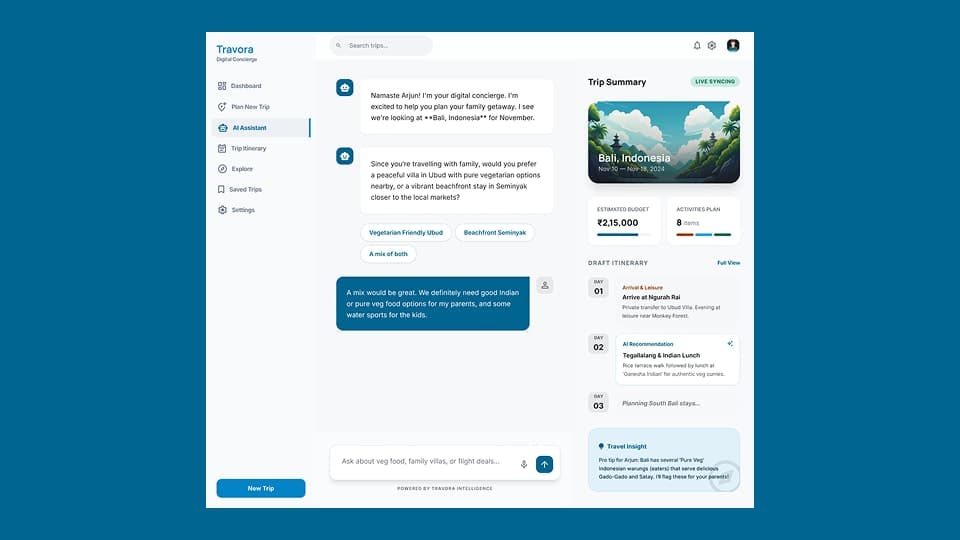
Agent Travora is an AI powered travel planning assistant designed to help users create personalized travel itineraries through natural conversation and smart recommendations.

Instead of manually searching across multiple travel platforms, users can interact with an intelligent agent that understands their preferences, travel style, and budget to generate a complete trip plan.

This project focuses on designing the information architecture and AI driven user journey behind such a system.

πŸ‘¨β€πŸ’» My Role

Product Designer

Responsibilities included

β€’ AI product architecture design
β€’ Conversational UX flow design
β€’ Information architecture creation
β€’ Trip planning workflow design
β€’ Personalization strategy

πŸ›  Tools

Designed in Figma
System mapping using Information Architecture Diagrams
2. Project Overview

✈ Travel planning today is fragmented across multiple platforms such as flight booking websites, hotel aggregators, itinerary planners, and local activity apps.

Users often spend hours switching between platforms just to organize a single trip.

Agent Travora was conceptualized as a single AI powered travel concierge capable of understanding user intent and generating a complete trip plan.

The system combines AI conversation, personalization, and itinerary generation into a single intelligent travel planning workflow.

3. Problem Statement

⚠ Planning a trip requires users to navigate through multiple tools and information sources.

This fragmented experience creates friction and often leads to incomplete travel plans.

πŸ‘€ Traveler pain points

β€’ Travel planning requires searching across multiple platforms
β€’ Users struggle to organize trip activities into a structured itinerary
β€’ Budget planning becomes difficult when costs are scattered across platforms
β€’ Many users lack inspiration when planning destinations

β€œPlanning a trip is exciting but also overwhelming because there are too many decisions.”
Travel user insight

4. Goals & Objectives

🎯 The goal was to design an AI powered travel planning architecture that simplifies trip planning through conversational interaction.

✨ Product goals

β€’ Create an AI travel assistant that understands natural language requests
β€’ Generate complete trip itineraries automatically
β€’ Allow users to customize travel plans easily
β€’ Provide intelligent suggestions based on travel preferences
β€’ Enable saving, sharing, and exporting trip plans

5. Target Users

πŸ‘₯ The system was designed for modern travelers who prefer smart digital planning tools.

🌍 Frequent Travelers

Want faster and smarter travel planning experiences.

πŸ‘¨β€πŸ‘©β€πŸ‘§ Family Travelers

Need structured itineraries that balance activities for all members.

πŸŽ’ Solo Travelers

Seek inspiration and recommendations for new destinations.

πŸ’Ό Busy Professionals

Prefer AI assistance that reduces planning effort.

6. Product Thinking

🧠 The product was designed around the concept of an AI travel concierge.

Instead of browsing multiple travel apps, users interact with a single assistant that understands travel goals and generates recommendations.

✨ Core product principles

Conversational planning

AI generated itineraries

Flexible trip customization

Centralized travel management

The platform acts as a digital travel agent available 24/7.

7. Information Architecture

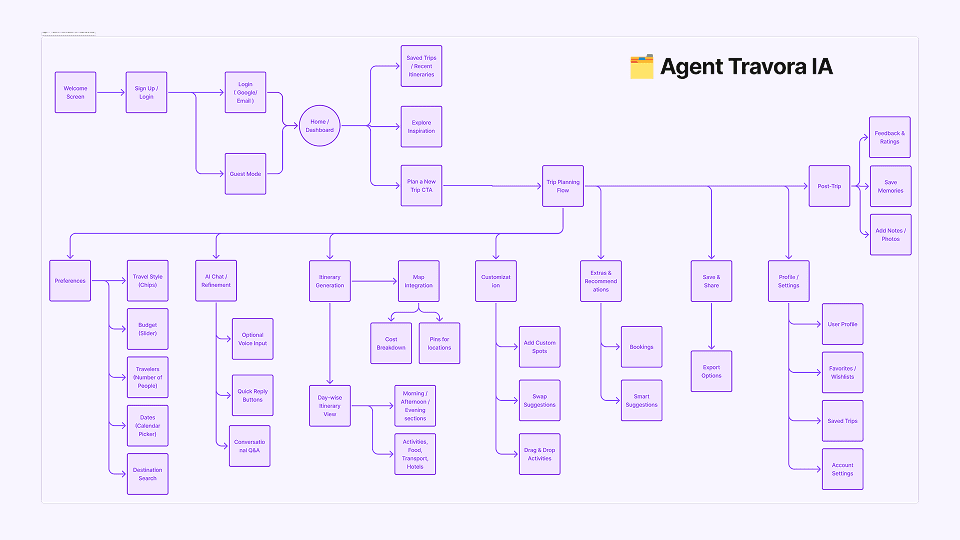
πŸ—Ί The platform architecture was designed to support a complete travel planning lifecycle.

Entry Points

Users begin their journey through

Welcome screen
Account sign in
Guest mode

Core Navigation

The main workspace includes

Dashboard
AI assistant
Trip itinerary
Explore destinations
Saved trips

Planning Modules

The trip planning workflow includes

Preferences setup
AI conversation refinement
Automatic itinerary generation
Map integration
Activity planning

Information Architecture 1

8. AI Conversation Flow

πŸ’¬ The AI assistant is the core interaction model of the platform.

Instead of filling long forms, users interact with a conversational interface.

The assistant collects key trip details including

Destination preferences
Travel dates
Budget range
Travel group size
Travel style

The conversation evolves dynamically as the system learns more about the user's preferences.

9. Trip Planning Workflow

🧭 The trip planning experience follows a structured workflow designed to gradually refine travel plans.

1️⃣ User enters travel preferences

Destination
Dates
Travel style
Budget

2️⃣ AI assistant generates a draft itinerary

3️⃣ Users refine the plan through conversation

4️⃣ System generates a day wise itinerary

5️⃣ Users customize activities and locations

6️⃣ Final itinerary can be saved, shared, or exported

10. Key Product Modules

βš™ The architecture includes several functional modules.

πŸ“ Preference Setup

Captures user travel details such as

Budget
Travel style
Trip dates
Number of travelers

πŸ€– AI Chat Interface

Handles conversation based planning and trip refinement.

πŸ—Ί Map Integration

Displays activity locations and travel routes visually.

πŸ“… Itinerary Builder

Generates day wise travel schedules.

🎯 Customization Tools

Users can modify the itinerary by

Adding activities
Swapping locations
Reordering plans

11. Personalization Strategy

🎯 Personalization is a core component of the system.

The AI assistant adapts recommendations based on

Travel preferences
Previous trips
Saved destinations
Budget constraints

This enables the platform to generate highly relevant trip plans for each user.

12. Post Trip Experience

🌍 The product extends beyond planning and supports post trip engagement.

✨ Post trip features include

Trip memories
Photo uploads
Travel notes
Trip feedback and ratings

This allows users to maintain a personal travel archive within the platform.

13. Design Challenges

🚧 Designing an AI travel assistant introduces several challenges.

Key challenges included

β€’ Structuring conversational inputs into structured trip data
β€’ Balancing automation with user control
β€’ Designing flexible itinerary editing
β€’ Creating a scalable architecture for future features

14. Key Learnings

πŸ’‘ This project emphasized the importance of system level thinking in product design.

AI products require strong information architecture before UI design.

Conversational interfaces must guide users while still allowing flexibility.

Travel planning is highly emotional and personalization significantly improves the experience.

15. Final Outcome

πŸš€ Agent Travora demonstrates how an AI assistant can transform travel planning into a simple conversational experience.

By combining AI interaction design, structured trip planning workflows, and intelligent recommendations, the system enables users to create personalized travel itineraries with minimal effort.