MVP vs Full Product Design: What Designers Should Know
When building digital products, teams often face an important question early in the product development process.
Should they launch quickly with a minimum viable product, or should they invest time in designing a fully developed product experience?
This decision influences how designers prioritize features, structure workflows, and collaborate with product teams.
Understanding the difference between MVP design and full product design helps UX designers create solutions that balance speed, usability, and long term product vision.
Both approaches play an important role in product development.
The key is knowing when and how to apply each one.
What Is an MVP
A Minimum Viable Product, commonly known as an MVP, is the simplest version of a product that solves a core user problem.
The goal of an MVP is to launch quickly while delivering enough value for users to begin using the product.
Instead of building every feature at once, product teams focus on the most important functionality needed to validate the product idea.
Typical characteristics of an MVP include:
- limited feature set
- simplified workflows
- basic interface design
- rapid development cycles
An MVP helps teams test ideas with real users before investing in full product development.
This approach allows teams to gather feedback, identify improvements, and reduce the risk of building unnecessary features.
Why MVP Design Matters
Many successful products started as MVPs.
Launching a simplified version allows teams to learn from user behavior early in the product lifecycle.
Benefits of MVP design include:
- faster product launch
- reduced development costs
- early user feedback
- validation of product ideas
- ability to iterate quickly
Without an MVP approach, teams may spend months building features that users do not actually need.
Designers play an important role in defining which features should be included in the MVP.
What Is Full Product Design
Full product design focuses on creating a complete and refined product experience.
Instead of building only the core functionality, teams design a broader system that includes multiple features, workflows, and integrations.
Full product design typically involves:
- advanced features
- detailed workflows
- scalable design systems
- polished user interfaces
- optimized user journeys
This approach is usually adopted after the product idea has been validated through earlier iterations.
Full product design focuses on improving usability, expanding functionality, and preparing the product for long term growth.
Key Differences Between MVP and Full Product Design
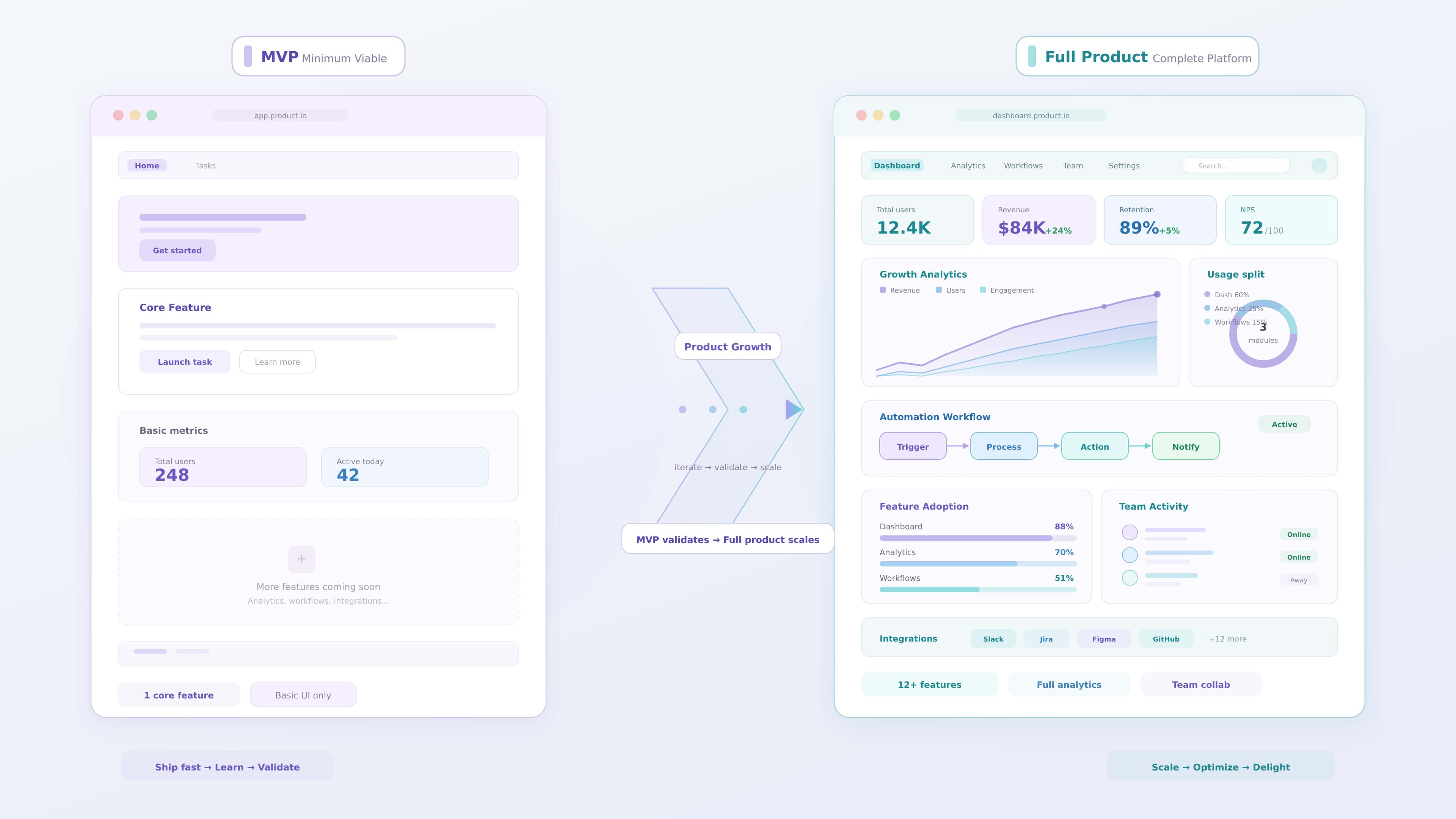
While both approaches focus on solving user problems, they differ in scope and priorities.
Product Scope
MVP design focuses on a small set of features that address the primary user problem.
Full product design includes a broader set of capabilities that support multiple workflows.
Design Complexity
MVP interfaces are often simpler because they focus on core functionality.
Full product design includes more detailed interactions and advanced features.
Development Time
MVP products are built quickly to test product ideas.
Full products require longer development cycles.
Product Goals
The goal of an MVP is validation and learning.
The goal of full product design is scalability and long term product success.
Understanding these differences helps designers make informed decisions during the design process.
How UX Designers Approach MVP Design
Designing an MVP requires careful prioritization.
UX designers must identify the minimum set of features required to solve the main user problem.
The MVP design process often includes the following steps.
Identify the Core User Problem
Designers begin by understanding the main problem the product aims to solve.
User research helps identify the most important pain points.
Define Essential Features
Next, designers determine which features are absolutely necessary for solving the problem.
Features that do not support the core value proposition are usually postponed.
Simplify User Workflows
MVP interfaces should prioritize simple and efficient workflows.
Complex interactions should be avoided in early versions.
Test with Real Users
Usability testing helps validate whether the MVP actually solves the user problem.
Feedback collected during testing informs future product improvements.
When Designers Should Focus on MVP
Designers should prioritize MVP design when:
- the product idea is still being tested
- user needs are not fully understood
- development resources are limited
- the market opportunity is uncertain
In these situations, speed and experimentation are more important than feature completeness.
When Full Product Design Is Necessary
Full product design becomes important once the product has validated its core concept.
At this stage, teams invest more effort into expanding functionality and improving usability.
Designers focus on:
- creating scalable design systems
- improving complex workflows
- refining interaction patterns
- supporting multiple user roles
Full product design helps transform early prototypes into mature digital platforms.
The Role of Design Systems in Full Product Design
As products grow, maintaining design consistency becomes increasingly important.
Design systems help teams maintain consistency across multiple features and screens.
A design system typically includes:
- reusable UI components
- color and typography guidelines
- interaction patterns
- documentation for developers
Design systems allow teams to scale product design while maintaining visual consistency.
Example: Designing a SaaS Product
Consider a startup building a project management platform.
An MVP version of the product might include only essential features such as:
- task creation
- task tracking
- basic collaboration
This allows teams to validate whether users find value in the platform.
Once the product gains traction, the team may expand the product with additional features such as:
- analytics dashboards
- automation tools
- integrations with other platforms
Through this process, the product evolves from a simple MVP into a full product ecosystem.
Common Mistakes in MVP Design
While MVPs are designed to be simple, teams sometimes misunderstand the concept.
Common mistakes include:
- launching products that provide too little value
- removing essential usability features
- ignoring user feedback
- prioritizing speed over user experience
An MVP should still deliver a meaningful experience even if it has fewer features.
Balancing Speed and User Experience
Designers must balance the need for speed with the need for usability.
Even an MVP should follow fundamental UX principles such as:
- clear navigation
- readable typography
- logical workflows
- accessible interactions
Good design ensures that users can still interact with the product effectively.
Product Evolution: From MVP to Full Product
Successful products often follow a predictable growth path.
A typical product evolution may include:
1 identifying the core user problem
2 designing an MVP solution
3 launching the product to gather feedback
4 improving features based on user insights
5 expanding the product into a full platform
Designers play a critical role throughout this evolution.
Key Takeaways
Understanding MVP and full product design helps UX designers contribute more effectively to product strategy.
Important principles include:
- MVP design focuses on validating ideas quickly
- full product design focuses on scalability and long term usability
- designers must prioritize features carefully
- user feedback plays a critical role in product evolution
Both approaches are essential for successful product development.
Conclusion
UX designers play a crucial role in shaping how products evolve from early concepts into mature platforms.
By understanding the difference between MVP design and full product design, designers can help teams launch products faster while ensuring long term usability and scalability.
Balancing speed, usability, and product vision is what allows modern digital products to succeed.