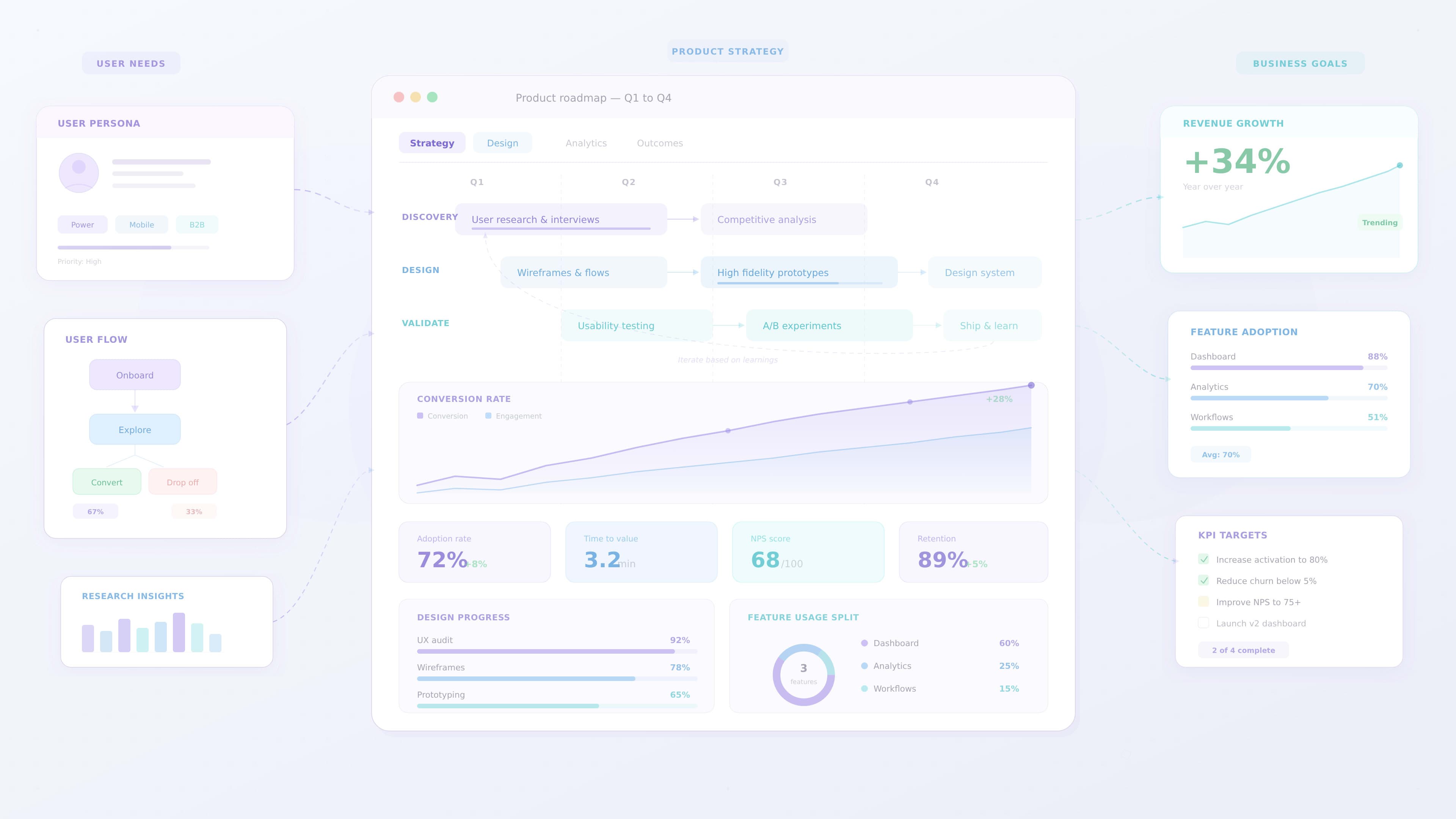
Product Thinking for UX Designers
Modern UX design goes far beyond creating attractive user interfaces. Designers today are expected to understand how products work, how businesses operate, and how user needs translate into meaningful solutions.
This mindset is known as product thinking.
Product thinking helps designers move from simply designing screens to solving real problems that impact both users and businesses.
Instead of focusing only on visual design, product thinking encourages designers to consider the entire product experience.
By adopting a product mindset, UX designers can create solutions that improve usability, support business goals, and contribute to long term product success.
What Is Product Thinking
Product thinking is an approach that focuses on understanding the relationship between user needs, business objectives, and product functionality.
Designers who apply product thinking consider questions such as:
- What problem does the product solve
- Who are the users and what do they need
- How does the product create value
- How will success be measured
Instead of designing isolated features, product thinking focuses on the overall experience and the value it delivers.
Product thinking connects design decisions with real world product outcomes.
When designers adopt this mindset, they contribute more strategically to product development.
Why Product Thinking Matters for UX Designers
Many products fail not because of poor visual design but because they fail to solve the right problem.
Product thinking helps designers avoid this mistake.
When designers understand the product context, they can:
- design solutions that solve real user problems
- align design decisions with business goals
- prioritize features effectively
- collaborate better with product teams
This approach helps designers move from execution roles to strategic contributors.
Organizations increasingly value designers who understand product strategy, not just interface design.
Understanding the Product Ecosystem
A product does not exist in isolation. It operates within an ecosystem that includes users, business goals, technology, and market conditions.
Product thinking requires designers to understand this broader ecosystem.
Important factors include:
- user behavior and needs
- business objectives
- technical constraints
- market competition
By understanding these factors, designers can make better design decisions.
For example, a feature that improves usability but conflicts with business goals may not be sustainable.
Product thinking helps designers balance these factors.
The Role of UX Designers in Product Strategy
UX designers play an important role in shaping product strategy.
Because designers work closely with user research and interaction design, they often have deep insights into user needs.
Designers contribute to product strategy by:
- identifying user pain points
- proposing solutions that improve workflows
- validating ideas through usability testing
- advocating for user centered design
This collaboration helps ensure that product decisions remain aligned with user needs.
Balancing User Needs and Business Goals
Successful products balance two important factors.
User value and business value.
A product that satisfies users but does not support business goals may struggle to survive.
Similarly, a product that focuses only on business objectives may create poor user experiences.
Product thinking encourages designers to find the balance between these priorities.
For example:
- improving onboarding flows may increase user adoption
- simplifying dashboards may improve productivity
- optimizing workflows may reduce operational costs
Design decisions that support both users and businesses are more likely to succeed.
Identifying the Right Problems to Solve
One of the most important aspects of product thinking is defining the right problem.
Designers often encounter situations where stakeholders propose solutions before understanding the problem.
Product thinking encourages designers to ask deeper questions such as:
- Why is this feature needed
- What problem are users experiencing
- How frequently does this problem occur
- What impact does the problem have
By understanding the root problem, designers can create more effective solutions.
Prioritizing Features in Product Design
Product teams often face limited resources and tight deadlines.
Not every feature can be built immediately.
Product thinking helps designers prioritize features that provide the most value.
Common prioritization frameworks include:
- impact versus effort analysis
- user value prioritization
- business goal alignment
Designers can use these frameworks to identify which features should be developed first.
This approach ensures teams focus on meaningful improvements rather than unnecessary features.
Designing for Long Term Product Growth
Products evolve over time.
A feature designed today may need to support future workflows and integrations.
Product thinking encourages designers to consider long term scalability.
This includes:
- designing flexible UI components
- building scalable design systems
- creating workflows that support future features
Designers who think about scalability help products grow more effectively.
Example: Product Thinking in Dashboard Design
Consider a business analytics dashboard used by managers to monitor company performance.
Without product thinking, designers might simply display charts and metrics.
However, product thinking encourages designers to ask deeper questions.
What decisions will managers make based on this dashboard?
Which metrics are most important?
How quickly do users need to access these insights?
By answering these questions, designers may restructure the dashboard to highlight key performance indicators and simplify data exploration.
This approach improves usability while supporting business decision making.
Common Mistakes Without Product Thinking
When teams focus only on interface design, they may encounter several problems.
Common mistakes include:
- designing features without understanding user needs
- adding unnecessary functionality
- ignoring business objectives
- creating complex workflows that reduce usability
Product thinking helps teams avoid these issues by focusing on meaningful outcomes.
Developing Product Thinking Skills
UX designers can develop product thinking skills through several practices.
These include:
- participating in product strategy discussions
- analyzing product metrics
- collaborating closely with product managers
- conducting user research regularly
Designers who engage with product strategy gain deeper insights into how digital products succeed.
Over time, this perspective strengthens their ability to create impactful design solutions.
The Future of Product Thinking in UX
As digital products become more complex, the role of UX designers continues to evolve.
Organizations increasingly expect designers to contribute to product strategy and decision making.
Product thinking will continue to play a critical role in modern UX design.
Designers who combine strong UX skills with product thinking will be better positioned to lead product innovation.
Key Takeaways
Product thinking helps UX designers move beyond interface design and focus on solving meaningful problems.
Important principles include:
- understanding user needs and business goals
- identifying the right problems to solve
- prioritizing features effectively
- designing scalable solutions
By adopting a product mindset, designers can contribute more strategically to product development.
Conclusion
Product thinking is an essential skill for modern UX designers. By understanding the relationship between user needs, business objectives, and product functionality, designers can create solutions that deliver real value.
Designers who adopt product thinking move from designing screens to shaping successful digital products.