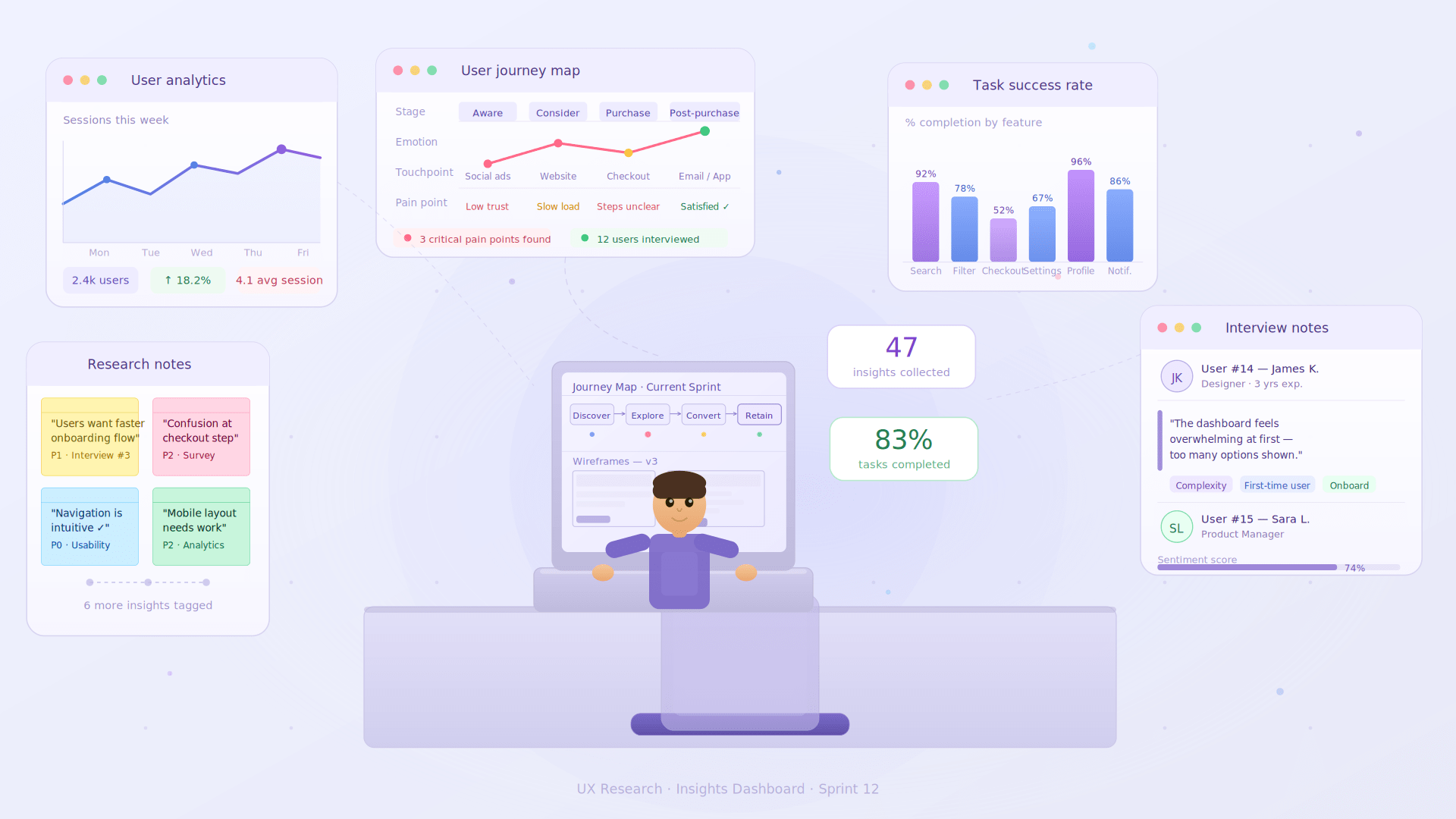
UX Research Methods for Product Designers
Introduction
Great product design begins with understanding users.
Many designers focus heavily on visual interfaces, but the real impact of UX design comes from research-driven decision making. Without research, design decisions are often based on assumptions rather than real user behavior.
UX research methods help product designers uncover:
- user needs
- behavior patterns
- usability problems
- product opportunities
In modern product teams, UX research is not limited to dedicated researchers. Product designers, product managers, and developers all rely on research insights to guide product decisions.
For example, in data-heavy SaaS products and enterprise dashboards, research often reveals that users struggle more with interpreting information than navigating interfaces.
Understanding these behaviors allows designers to create products that align with real workflows instead of assumptions.
If you're interested in the strategic mindset behind UX decision making, you may also explore topics like Product Thinking for UX Designers and How UX Designers Solve Complex Problems.
In this guide, we’ll explore the most important UX research methods for product designers and how they help teams design better products.
Why UX Research is Critical in Product Design
Many product teams skip UX research due to time constraints or tight release cycles.
However, skipping research usually leads to bigger problems later.
Common issues caused by poor research include:
- products solving the wrong problem
- confusing navigation structures
- features that users rarely use
- poor user adoption
- frequent redesign cycles
UX research helps teams answer critical product questions:
- What problem are we solving?
- Who are our users?
- How do users currently solve this problem?
- What frustrations exist in current workflows?
- What outcomes do users want?
These insights allow product teams to design solutions that truly address user needs.
In complex SaaS environments, research also helps designers understand how different user roles interact with the product.
For example:
- executives often need high-level insights
- analysts need deep data exploration tools
- operational teams require real-time information
Understanding these differences allows designers to create role-specific product experiences.
UX research ensures product decisions are based on real user behavior instead of internal assumptions.
Key UX Research Methods Every Product Designer Should Know
Different research methods support different stages of the design process.
Some methods help discover problems, while others validate design solutions.
Here are five essential UX research methods used in modern product teams.
1. User Interviews
User interviews involve direct conversations with users to understand their needs, workflows, and challenges.
They are especially valuable during the early discovery phase of product design.
User interviews help designers learn:
- how users perform tasks
- what tools they currently use
- what frustrations they experience
- what improvements they expect
Example interview questions include:
- How do you currently complete this task?
- What problems do you face with your current tools?
- What would make your workflow easier?
These conversations often reveal insights that are difficult to identify through analytics or surveys.
For example, when designing enterprise dashboards, interviews may reveal that leadership users prioritize high-level summaries, while operational users require detailed performance metrics.
Understanding these needs allows designers to structure information more effectively.
2. Usability Testing
Usability testing evaluates how easily users can interact with a product interface.
It involves observing real users as they attempt to complete tasks using prototypes or existing interfaces.
Usability testing helps identify:
- confusing navigation
- unclear actions
- difficult workflows
- unexpected user behavior
Typical usability testing tasks may include:
- locating important data within a dashboard
- completing onboarding steps
- generating reports
- navigating between features
Watching users complete these tasks often reveals usability issues designers did not anticipate.
Even testing with five users can uncover the majority of critical usability problems.
Usability testing is most valuable during the prototype validation stage, where design decisions can still be refined before development.
3. Surveys
Surveys allow designers to collect feedback from a large group of users.
They are useful for identifying:
- feature priorities
- satisfaction levels
- user preferences
- product feedback
Surveys typically include:
- multiple choice questions
- rating scales
- open feedback responses
For example, SaaS product teams often use surveys to learn:
- which features users rely on most
- which features are difficult to use
- what improvements users want
Surveys provide valuable quantitative insights but work best when combined with qualitative research like interviews.
This combination helps teams understand both user behavior and user motivations.
4. Analytics Research
Analytics research examines real user behavior through product data.
Analytics tools track how users interact with digital products.
Common tools include:
- Google Analytics
- Mixpanel
- Amplitude
- Hotjar
Analytics data can reveal:
- which features are used most
- where users drop off
- navigation patterns
- engagement trends
For example, analytics might reveal that a certain dashboard module receives very little interaction.
This insight may indicate:
- discoverability problems
- unnecessary features
- unclear navigation
Design improvements can then focus on improving workflow clarity rather than adding new functionality.
Analytics research is essential for continuous product improvement.
5. Competitive Analysis
Competitive analysis examines how other products solve similar problems.
This research method helps designers understand:
- industry design patterns
- common UX solutions
- expected features
- opportunities for innovation
For example, most modern SaaS dashboards share common patterns such as:
- KPI summary cards
- filtering systems
- activity timelines
- customizable widgets
These patterns help users quickly understand new products because they align with familiar mental models.
However, competitive analysis should inspire improvements rather than copying existing solutions.
The goal is to identify what works in the market while designing better experiences.
When to Use Each UX Research Method
Effective UX research involves selecting the right method for each stage of the design process.
Discovery Stage
Use:
- user interviews
- surveys
- competitive analysis
Goal: understand the problem space.
Definition Stage
Use:
- analytics insights
- workflow analysis
Goal: identify opportunities for improvement.
Design Stage
Use:
- usability testing
- prototype testing
Goal: validate design solutions.
This structured approach ensures research supports every stage of product development.
Common UX Research Mistakes Designers Should Avoid
Even experienced designers sometimes make mistakes when conducting research.
Asking Leading Questions
Leading questions can bias user responses.
Instead of asking:
Do you like this design?
Ask:
How would you normally perform this task?
Neutral questions produce more accurate insights.
Starting Research Too Late
Research should begin before design begins.
Late research can reveal issues that require costly redesign.
Ignoring Small Sample Sizes
Even a small number of research sessions can reveal valuable insights.
Testing with just a few users can uncover major usability problems.
Relying Only on User Opinions
User opinions matter, but observed behavior often provides deeper insights.
Watching users interact with a product reveals issues that feedback alone may miss.
How UX Research Improves Product Decisions
UX research strengthens product decisions in several ways.
Research helps teams:
- prioritize the right features
- improve usability
- reduce design assumptions
- validate product ideas
- improve overall user experience
In complex SaaS products, research often reveals hidden workflow patterns that reshape product architecture.
For example, many dashboard users prefer:
- quick overview insights
- clear visual indicators
- drill-down access to detailed data
Designing interfaces around these patterns dramatically improves usability.
Research transforms design from a visual discipline into a strategic product practice.
Key Takeaways
UX research methods are essential for product designers.
Key insights include:
- research reduces design assumptions
- user interviews reveal real workflows
- usability testing uncovers interaction problems
- analytics reveals behavioral patterns
- competitive analysis identifies industry trends
Designers who integrate research into their workflow create better products and better user experiences.
Conclusion
UX research is the foundation of effective product design.
While visual design shapes the interface, research shapes the product strategy behind it.
Teams that invest in UX research gain deeper insight into user needs, enabling them to design products that truly solve problems.
For designers working on complex SaaS platforms and enterprise dashboards, research-driven design becomes even more critical.
Understanding users is what ultimately transforms good interfaces into great product experiences.