Dashboard

PartnerMesh - Admin Dashboard

Enterprise B2B partner management platform enabling administrators to manage distributors, product catalogs, orders, invoices, payments, and analytics through a centralized operational dashboard.

Enterprise DashboardSaaS PlatformPartner Management SystemB2B PlatformAdmin DashboardProduct Catalog SystemAnalytics DashboardOperational Management
PartnerMesh - Admin Dashboard - UI/UX design case study by Saurabh Pansari

1. Project Hero

🚀 PartnerMesh Admin Platform

PartnerMesh is a B2B partner ecosystem management platform designed to help organizations manage distributors, products, financial workflows, and operational processes from a centralized admin interface.

The system acts as the control center for technology distribution networks, allowing administrators to oversee product catalogs, partner relationships, and financial transactions.

The admin dashboard integrates multiple operational workflows including:

• Partner onboarding and lifecycle management
• Product catalog management for hardware and software products
• Inquiry and order lifecycle tracking
• Invoice and credit note management
• Payment verification and financial monitoring
• Role-based user access management

The design goal was to build a scalable enterprise platform capable of managing complex partner ecosystems while maintaining clarity across data-heavy operations.
2. Project Context

🏢 Product Context

Organizations managing technology distribution networks often rely on fragmented systems for partner onboarding, order management, and financial reconciliation.

These disconnected systems create operational inefficiencies and limit visibility into partner activity and product distribution.

PartnerMesh was designed as a centralized enterprise platform that integrates partner management, product distribution, and financial operations into a unified admin dashboard.

The system enables internal teams to manage distributor networks while maintaining visibility across operational performance and financial transactions.

3. Business Challenge

⚠️ Operational Challenges

Managing a partner-driven distribution ecosystem introduces several operational challenges.

• Partner onboarding processes are inconsistent and manual
• Product catalogs span multiple vendors and product categories
• Financial operations such as invoices and payments lack centralized visibility
• Operational teams struggle to track partner inquiries and order activity
• User permissions must be carefully controlled across multiple internal teams

Without a centralized system, administrators struggle to maintain operational efficiency and financial transparency.

The challenge was to design a single operational platform capable of handling complex partner workflows while remaining intuitive and scalable.

4. Design Objectives

🎯 Design Objectives

The design strategy focused on building a scalable enterprise platform capable of supporting complex distribution ecosystems.

Primary objectives included:

• Centralize partner ecosystem management
• Simplify product catalog administration
• Improve financial visibility across invoices and payments
• Enable efficient inquiry and order lifecycle tracking
• Implement secure role-based access control
• Provide analytics dashboards for operational insights

The platform needed to balance high operational complexity with a clear and intuitive user experience.

5. Target Users

👥 Target Users

The platform supports several internal stakeholders responsible for managing partner operations.

Platform Administrators
Manage system configuration, partner ecosystems, and operational monitoring.

Operations Teams
Handle partner inquiries, order processing, and product catalog updates.

Finance Teams
Manage invoices, credit notes, payments, and financial reconciliation.

Partner Management Teams
Responsible for onboarding partners and managing partner relationships.

6. Product Architecture

🧩 Product Architecture

PartnerMesh follows a modular architecture where each operational function is organized into dedicated modules.

Core modules include:

• Analytics Dashboard
• Partner Management
• Product Catalog
• Order Management
• Inquiry Management
• Financial Operations
• User Management
• Activity Logs
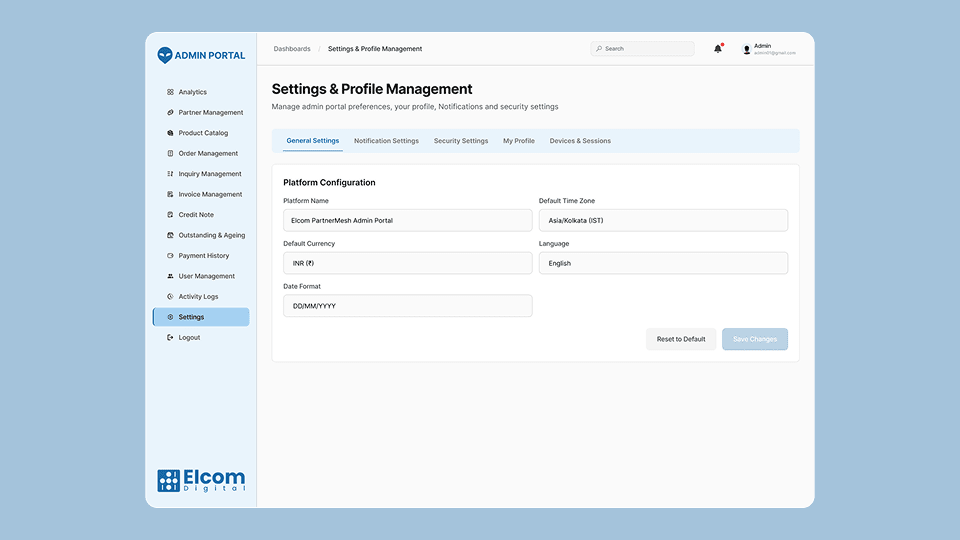
• Settings

Each module supports a specific operational workflow while maintaining consistent navigation across the platform.

This modular architecture ensures the platform remains scalable as the partner network and product catalogs grow.

7. Information Architecture

🧠 Information Architecture

The system navigation is designed to support data-heavy enterprise workflows.

Primary Navigation Structure

• Analytics
• Partner Management
• Product Catalog
• Order Management
• Inquiry Management
• Financial Operations
• User Management
• Activity Logs
• Settings

Each module contains detailed operational views that allow administrators to move from high-level analytics to detailed partner or financial information.

This architecture ensures efficient navigation across complex enterprise workflows.

8. Design Process

🎨 Design Process

Designing PartnerMesh required a structured product design approach to handle complex operational workflows.

Research & Discovery

Understanding how partner distribution ecosystems operate and identifying pain points in partner management, product catalogs, and financial operations.

Workflow Mapping

Mapping operational workflows including partner onboarding, inquiry management, order processing, and financial reconciliation.

Information Architecture

Structuring platform modules to organize partner operations, product distribution, and financial workflows.

Wireframing

Designing layout structures for enterprise dashboards with large datasets and operational tables.

UI Design

Creating scalable UI patterns that support financial data, operational metrics, and partner management interfaces.

Design System Development

Building reusable UI components in Figma to ensure consistency across dashboards, tables, forms, and analytics modules.

9. Partner Ecosystem Management

🤝 Partner Ecosystem Management

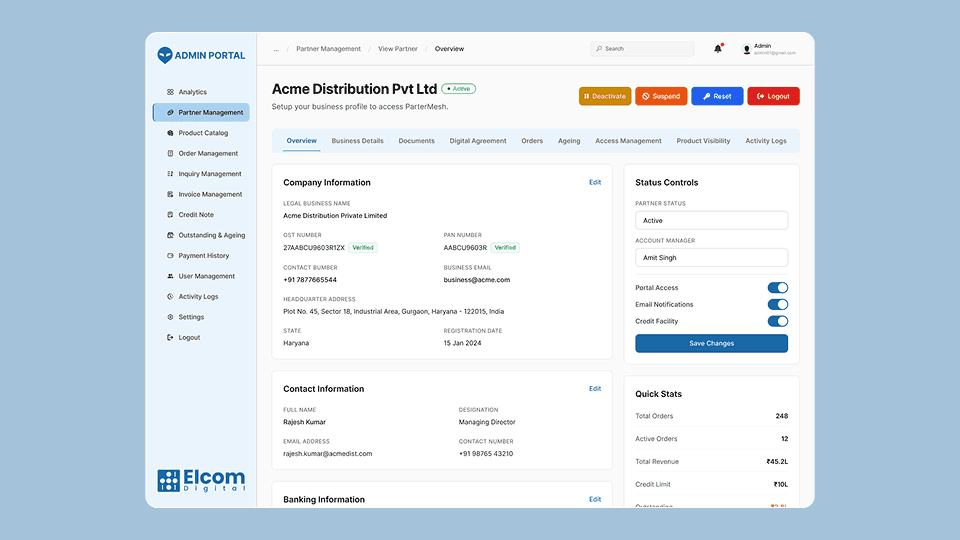
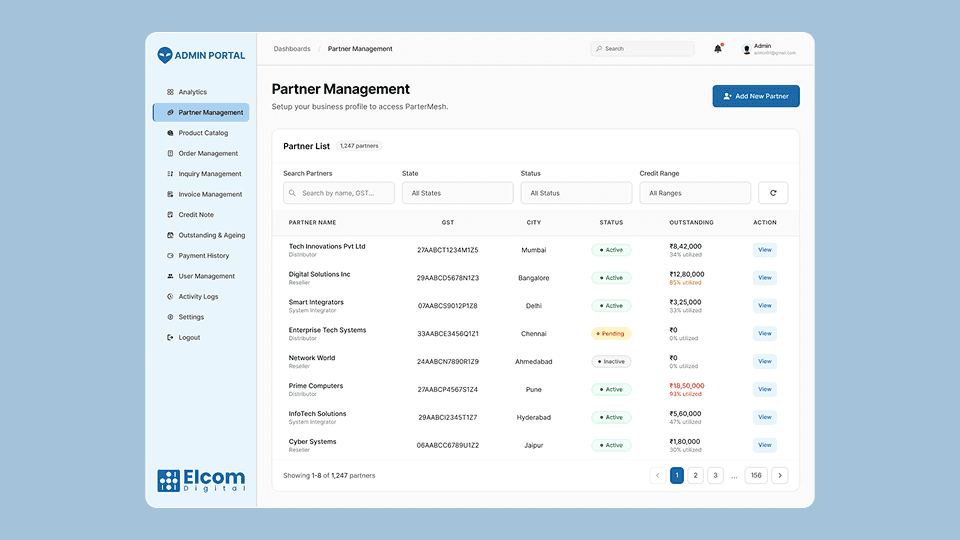
The Partner Management module enables administrators to manage the full lifecycle of distributor partners.

Partner profiles include several operational views:

• Business profile information
• Partner documents and verification records
• Digital partner agreements
• Order history and transaction records
• Outstanding invoices and ageing reports
• Product visibility permissions
• Activity logs

This module acts as the central hub for managing partner relationships and monitoring partner performance.

10. Product Catalog Strategy

📦 Product Catalog Strategy

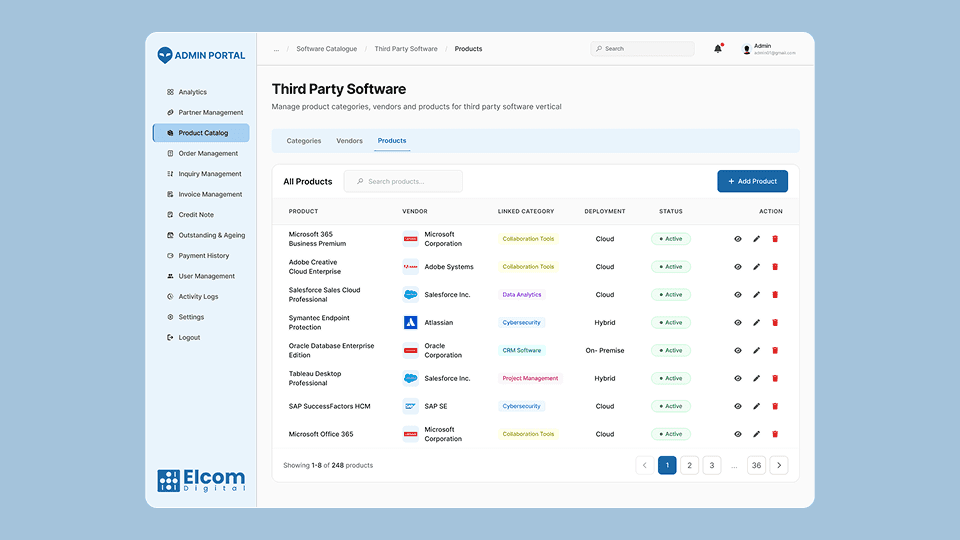
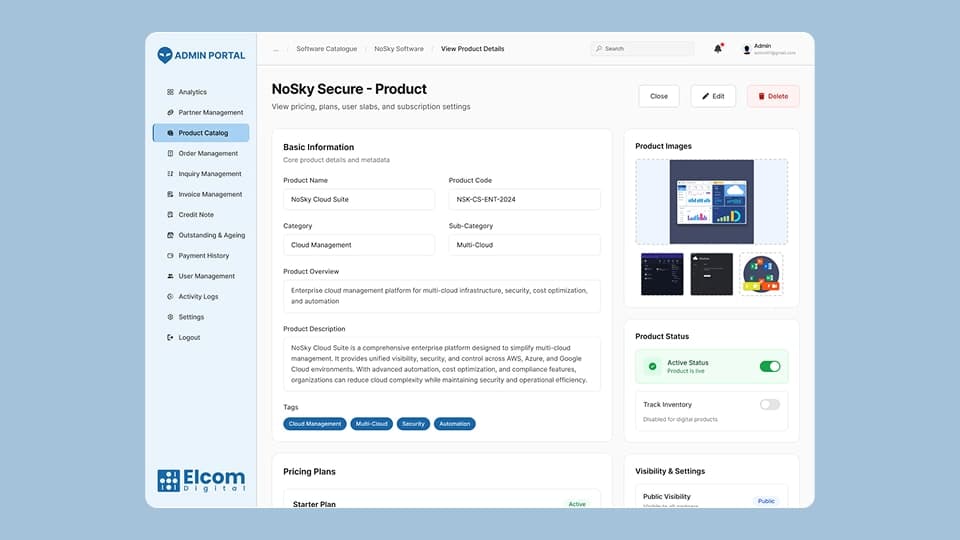
PartnerMesh supports both hardware and software product distribution.

Hardware Catalog

• Hardware categories and product listings
• Brand and SKU management
• Detailed product specifications

Software Catalog

• Internal software products
• Vendor-provided software products
• Licensing models and categories

This catalog structure allows administrators to maintain consistent product data across multiple vendors and distribution partners.

11. Financial Operations

💰 Financial Operations

Financial workflows are managed through multiple modules designed to track transactions and partner payments.

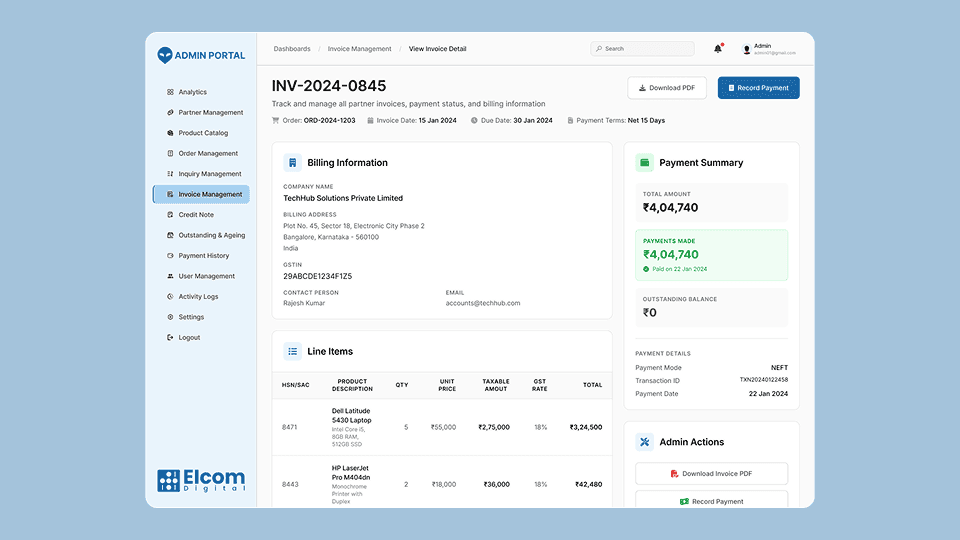
Invoice Management

Administrators can track invoices generated for partner purchases and review invoice details.

Credit Note Management

Credit notes are issued for:

• Product returns
• Pricing adjustments
• Damaged goods

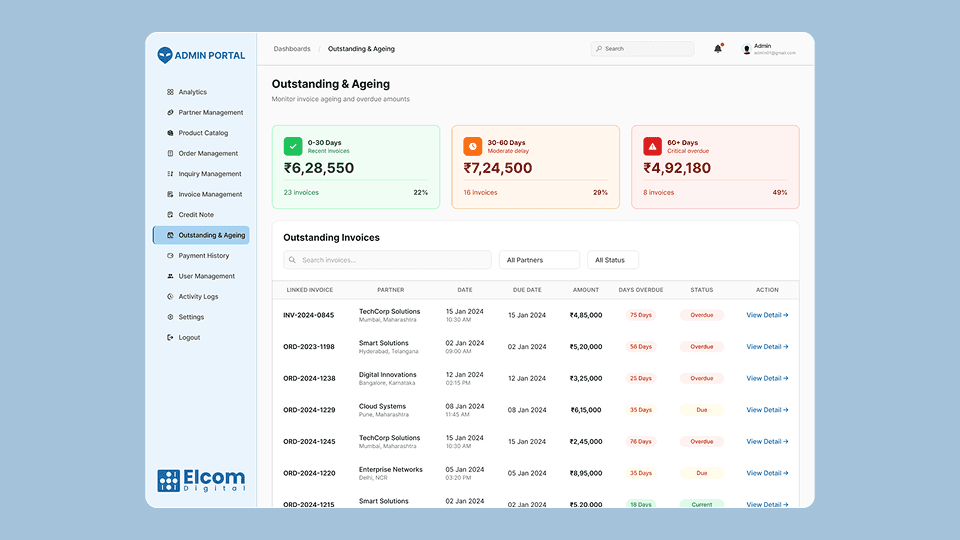
Outstanding & Ageing

Invoices are categorized into ageing brackets:

• 0–30 days
• 30–60 days
• 60+ days

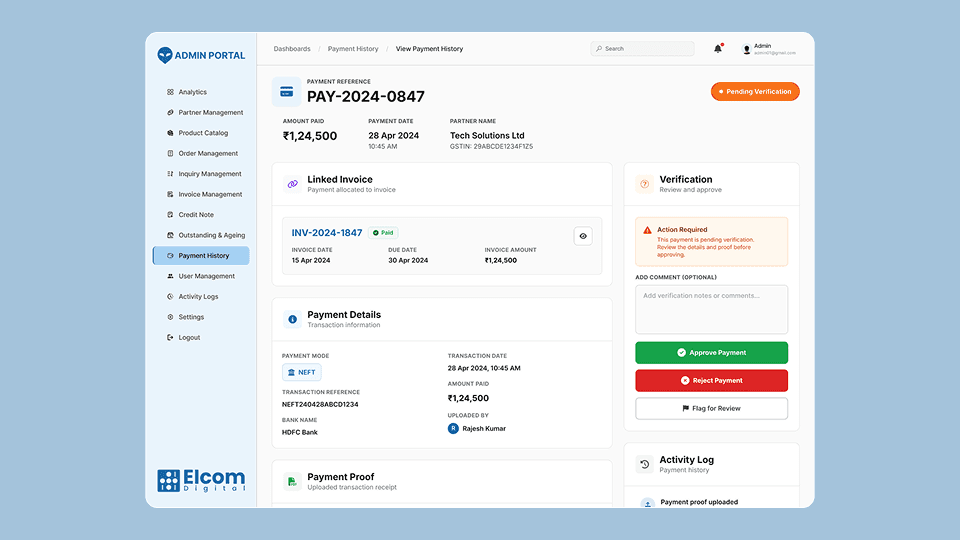
Payment Verification

Partners upload payment proof, which administrators review and approve before updating payment records. :contentReference[oaicite:2]{index=2}

12. Data Visualization Strategy

📊 Data Visualization Strategy

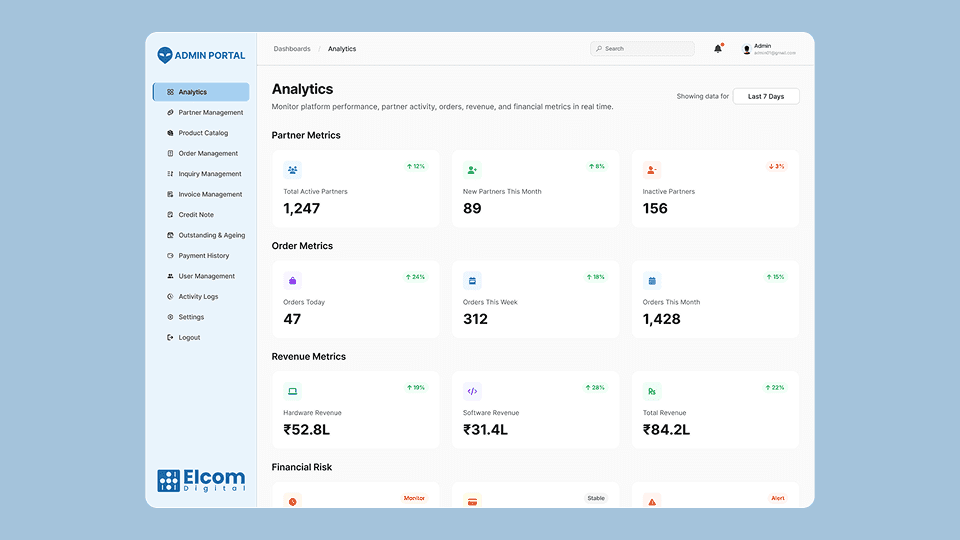
The analytics dashboard provides operational insights across partner activity and financial performance.

Key metrics include:

• Revenue performance trends
• Order volume and inquiry metrics
• Outstanding balances and credit limits
• Product performance metrics

These visualizations help administrators quickly identify trends and monitor operational health across the partner ecosystem.

13. Key Screens

🖥 Key Screens

Several core screens were designed to support complex operational workflows within the admin platform.

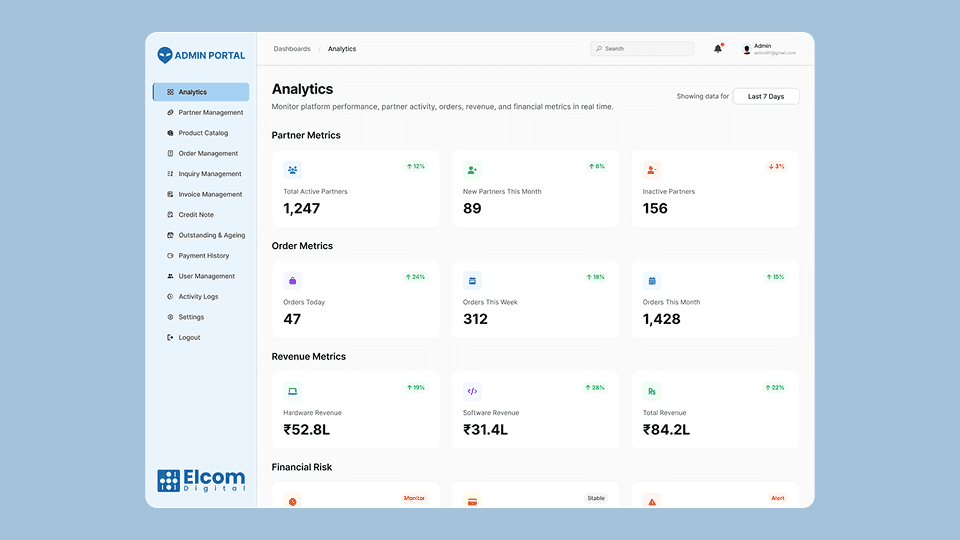
Analytics Dashboard

Provides a high-level overview of platform performance including revenue trends, order metrics, and outstanding balances.

Partner Management

Displays partner profiles including business details, orders, financial records, and operational activity logs.

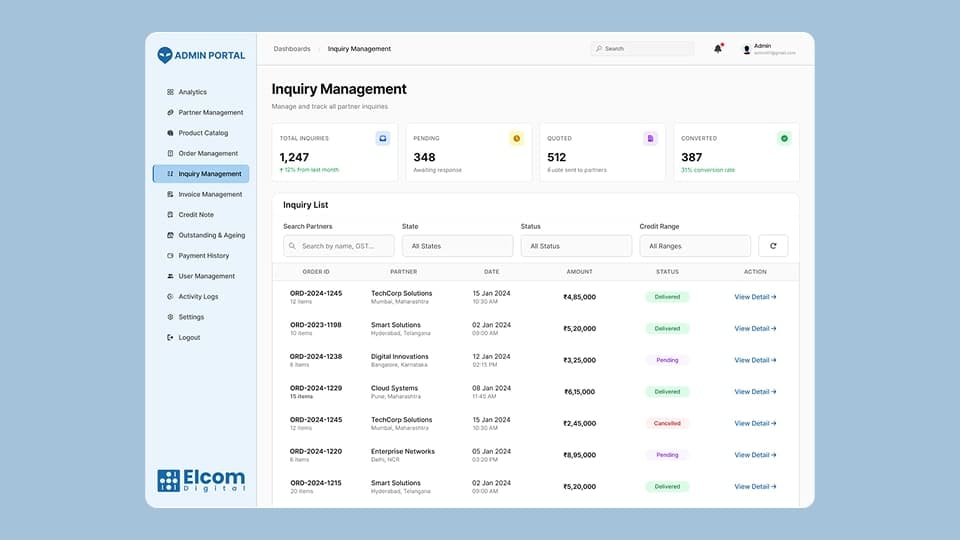
Inquiry Management

Allows administrators to review partner product inquiries, track inquiry status, and respond to requests efficiently. :contentReference[oaicite:3]{index=3}

Payment Verification

Administrators can review uploaded payment proof, verify transaction details, and approve or reject payments before financial records are updated. :contentReference[oaicite:4]{index=4}

Invoice Management

Displays invoices generated for partner transactions, allowing administrators to monitor payment status and financial activity.

User Management

Allows administrators to create internal users, assign roles, and configure permission matrices for system access.

Key Screens 1
Key Screens 2
Key Screens 3
Key Screens 4
Key Screens 5
Key Screens 6
Key Screens 7
Key Screens 8
Key Screens 9
Key Screens 10

14. Role Based Access Control

🔐 Role Based Access Control

Enterprise platforms require strict access control mechanisms.

PartnerMesh implements role-based permissions allowing administrators to control access to system modules.

Permissions can be assigned for actions such as:

• Viewing partner data
• Managing product catalogs
• Processing orders
• Managing financial data
• Configuring system settings

This ensures that sensitive operational and financial data remains secure.

15. Design System

🎨 Design System

A scalable design system was created to maintain visual consistency across the platform.

Key design principles included:

• Modular UI components for dashboards
• Consistent typography and spacing
• Structured table layouts for large datasets
• Clear visual hierarchy for financial data

Reusable components were created in Figma to ensure scalability as new modules are added to the platform.

16. Design Challenges

Design Challenges

Designing PartnerMesh required addressing several enterprise UX challenges.

Complex Financial Data

Invoices, credit notes, and payments required clear hierarchy and visibility.

Large Data Tables

Enterprise systems contain large datasets requiring efficient filtering and sorting mechanisms.

Partner Ecosystem Complexity

Each partner has unique agreements, product catalogs, and financial records.

Balancing operational complexity with usability was a key challenge throughout the design process.

17. Key Learnings

📚 Key Learnings

Working on PartnerMesh provided valuable insights into enterprise platform design.

• Enterprise dashboards require strong information architecture
• Financial workflows demand precise UI hierarchy
• Access control systems are critical for enterprise platforms
• Data-heavy systems must prioritize readability and filtering

The project reinforced the importance of designing scalable operational platforms that simplify complex workflows.

18. Final Outcome

🏁 Final Outcome

PartnerMesh delivers a centralized enterprise platform for managing partner-driven distribution ecosystems.

The platform enables administrators to:

• Manage distributor partners and agreements
• Track product distribution across vendors
• Monitor invoices, payments, and financial performance
• Control user permissions and system access
• Analyze operational performance through analytics dashboards

The final product improves operational transparency, financial visibility, and efficiency across the partner ecosystem.

19. Figma Prototype Embed